
The Central Rappahannock Chapter of the Virginia Master Naturalists has created
a new web site
Click here for new site
The site will take over from this blog and will offer photos, newsletters,an email contact page and more.
Please use the new site, as this blog will not continue to be updated. Thank you!
August 5, 2022

March 29, 2022
Montpelier Seasonal Woods Walk - April 7, 2022
Montpelier is hosting its seasonal woods walk on April, 7. It is a 2-hour walk through the oldest non-logged forest in the eastern US. Cost is $12 per person and the registration available on-line at https://www.montpelier.org/events/seasonal-woods-walk.
March 27, 2022
2022 Master Naturalist Basic Training Course
Planning is underway for the 2022 basic training course. The training generally starts in late summer or early fall. Please check back with us later for more information.
February 20, 2021
Great Backyard Bird Count

January 10, 2021
Extension to Achieve Initial Certification for Basic Training Class of 2019
In the face of the pandemic and cancellation of many events to earn continuing education and volunteer hours, members of the Basic Training class of 2019 have had difficulty achieving initial certification. The VMN CRC Board has decided to extend the certification timeline for the class through December 31, 2021. Requirements for initial certification are 8 continuing education units and 40 volunteer hours. We are working hard to continue scheduling chapter events to make continuing education hours available through virtual events or small in person events until state restrictions are lifted. There are volunteer opportunities than can be achieved individually either at home or at local parks and trails. If you need ideas for volunteer hours please check the August 2020 newsletter or contact a board member.
July 6, 2020
June 15, 2020
Searching for Feathers
Searching for Sheds, in a recent Virginia Department of Game and Inland Fisheries magazine Virginia Wildlife, highlighted the time of year when White-tailed Deer (Odocoileus virginianus) shed their antlers and how individuals can walk through the forest on a shed hunt, to collect those shed antlers. Many of us have come upon antlers in the woods and just after reading this article, I was awarded with a find of a freshly shed antler while on a walk in the woods. I leave antlers where I found them as I understand they provide minerals for squirrels and other residents of the woods.

My interest in feathers began when I photographed a feather and included that observation on iNaturalist. I used the taxonomic class Aves, since I couldn’t determine a species from a feather. I found informed professionals and amateurs in groups formed around feathers - https://www.inaturalist.org/projects/found-feathers. I have posted images of feathers that I am unsure to identify and have been helped by folks who really enjoy feather identification. Also, the Fish and Wildlife Service has a nice feather atlas - https://www.fws.gov/lab/featheratlas/.
Recently, while walking along the Dahlgren Rail Heritage Trail, I came upon feathers scattered about. I arranged them for one photograph. I was unsure what species produced these black and white feathers. I figured maybe a woodpecker from the colors but also, maybe they were from some sort of small water bird due to the marshy area nearby.
After posting on iNaturalist, I confirmed that these feathers were from a Pileated Woodpecker (Dryocopus pileatus).
After a taxonomic suggestion from a “bird person,” a “feather person,” or just someone smarter than me, identification becomes obvious, many times.
I leave feathers where I found them. On this occasion, I oriented feathers for a photograph but most times, they get photographed as they exist. The U.S. Federal Eagle Protection Act of 1940 and the Migratory Bird Treaty Act of 1918 seem to prohibit possession of many if not all feathers. I suspect the legal aspects are more nuanced but I follow, don’t collect feathers, just enjoy them where you find them.
Observing, identifying, and documenting feathers can be interesting, fun, and an easy activity. Feather awareness is just another layer of appreciation while on a walk outside.
May 15, 2019
Baby Barn Owl Banding
 |
| Photo credit: Corie Smith |
Not
even the threat of downpours could dampen the excitement of a baby barn owl
viewing. Ready with boots, raincoats and umbrellas, chapter members Corie Smith
and Jenna Veazey ventured across the Potomac river to Maryland to support the
Southern Maryland Audubon Society’s (SMAS) banding of baby Barn Owls on May 5th.
Corie
and Jenna joined a group of other volunteers and supporters that met on private
property along the Wicomico River, which the group was instructed not to share
the exact location of…for the safety of the owls. Barn owls are rare breeders
in Maryland and are listed as In Need of Conservation.
Mike
Callahan, who also works as an interpreter at Caledon State Park in King
George, is a member of the SMAS. The group had been closely monitoring an owl
box on private property. Mike said there were only three known nests in Charles
County, Maryland.
Their
best guess was that this nest’s eggs had hatched the end of April. Barn owls
incubate their eggs as soon as they the first one is laid, opposed to ducks,
geese and songbirds which incubate after the last egg has been laid. And when the owlets have grown enough feathers
to maintain their body weight the parents don’t hang around the nest all day
anymore. There appeared to be five owlets, but as siblicide is not uncommon the
volunteers were cautiously optimistic we’d be able to tag all five on the banding
day.
 |
| Photo credit: Corie Smith |
Just
as the rain abated, Mike climbed the ladder up to the owl box. He urged everyone
to listen for the owlet’s hissing…which he said had been described as an
espresso machine. Very accurate, indeed! It didn’t take long after the
extraction of the first owlet for the hissing to turn into all-out shrieks. Five
owlets were carefully removed one-by-one and placed into individual cardboard
boxes for safe transport to the pavilion where they’d receive their ID bands. Mike
then called out for an extra box…there was a bonus sixth owlet that had been
hidden in previous observations!
Under
cover of a pavilion, USGS licensed bird bander, Ken Smith was in charge of banding
the owlets. He used size 7A aluminum bands specially gauged for barn owls, each
with their own unique identifying number. He explained the owlets’ legs were
already about as large as they'd get at this age and there was no worry that
the bands would grow too tight over time. As he worked, he also said that while
handling the owlets they had to be especially careful not to break any of their
flight feathers.
 |
| Photo credit: Corie Smith |
Mike
pointed out that barn owls have one toe with a pectinate comb, which they use
to groom the feathers on their facial discs.
Kerry
Wixted, Maryland DNR Wildlife Educator and Outreach specialist was also helping
out. She said that, “Barn owls are have been hit hard by habitat loss,
especially in Maryland. Grasslands with abundant voles and other rodents are
important for barn owls as well as open marshes.”
If
you would like to support local barn owl conservation in Maryland, consider
'adopting' an owl or other species through the SMAS program: https://www.somdaudubon.org/adopt-a-raptor/
March 7, 2019
February Chapter Meeting - Upcoming Continuing Education and Volunteer Opportunities
To be certified and maintain certification every year as a Virginia Master Naturalist, volunteers are required to complete 8 hours of continuing education and 40 hours of volunteer work. Here are some great opportunities
Announcements:
Announcements:
Next Board meeting Thursday 3/7 @ Wegman’s 7 pm (open to all members)
Next Chapter meeting Tuesday 3/19 @ church 7 pm
Master Naturalist Volunteer Opportunities:
- 3/9/19: Mott's Nature Center Volunteer Orientation - 9-11 am. Register with Alexa at Fredericksburg Parks and Rec.
- 3/22/19: Friends of the Rappahannock - Rappahannock County Tree Planting Project 9:30 - 1 pm, volunteers needed to plan trees, sign up at Friends of the Rappahannock Events page
- 4/1/19: Homeschool Day at Montpelier (Orange County) - volunteers needed for "Noticing Nature Table and Walks" contact Madelyn from CRVMN
- 4/2/19: Tri-County Aspen Grove Meaningful Watershed Educational Field Day (Rain Date April 4th - contact Mariya at TriCounty Water
- 4/6/19: Spring Forest Stroll at Montpelier (Orange County) - volunteers needed to answer questions during the walk
- 4/13/19: Osprey Festival @ Caledon State Park. Opportunities to volunteer to give talking points/lead bird walk, native plant information, backyard habitat. Chapter can have a booth there. Caledon is coordinating event with Joyce from Colonial Beach.
- 4/22/19: Earth Day at AP Hill volunteers needed Dahlgren has asked that an Earth Day education outreach take place on April 22 at the elementary school on base. It will be from 1-3 pm. Volunteers needed.
- 4/27/19: Earth Day at Old Mill Park on, rain or shine - volunteers needed
- 4/27/19: Earth Day in Orange, VA - volunteers needed - contact Dena from CRVMN
- 5/18/19: Eco Rodeo at Montpelier (Orange County) - volunteers needed for "Noticing Nature Table and Forest Walks" contact Madelyn from CRVMN
- Widewater State Park looking for volunteers for monthly cleanups
- March Saturdays noon-2 pm - Salamander Survey at Jennings Farm - contact Dena with CRVMN
Continuing Education:
- 3/9/19: VA Native Plant Society Winter Workshop - Our Changing Forests: Forest Health, Management and Restoration
- 3/23/19: Friends of the Rappahannock Wild and Scenic Film Festival @ UMW.
- 4/11-12/19: Spring Wildflower Identification Workshop - Blandy Experimental Farm
- 4/13/19: Garden Symposium: Wild about Natives 8:30 - 3:30 pm at Belmont in Falmouth
- 4/27/18: Montpelier - Orange County, VA - Native Plants and Animals in Harmony Exploration Walk - includes walk through the Landmark Forest
- Ongoing - VA Master Naturalists Webinars - Next March 28th on Maple Syrup Productions
February 28, 2019
Paleo Walk at Stratford Hall
Harry P. was able to arrange an opportunity for the Central Rappahannock Master Naturalists to visit the private beach area of Stratford Hall (located in Westmoreland County) to learn about and hunt for fossils. I have to admit this has been on my bucket list for years.
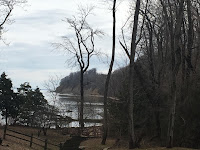 We met fairly early at the Stratford Hall Visitor Center, where we were introduced to our guides. There was a discussion on the types of fossils that have been found, including the favored Megladon teeth and some of the rare finds that have been made. While a ticket to Stratford Hall will allow access to the beach, that access is restricted to a small area. We had received special permission to walk past the ropes and head far up the beach. To provide a more hands on experience the two guides split us into two groups and we heading in opposite directions.
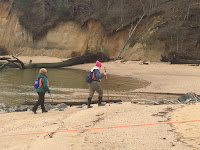 Armed with waterproof boots, bucket, small shovel and an inexpensive plastic colander I followed our guide Theresa. The weather was perfect, a bit cool but not uncomfortable. We walked along the beach at low tide, Theresa pointing out how to look for sharks teeth, bone, fossilized shells and the like. She pointed out the cliffs (you do not want to walk too closely, a large piece fell while we where there) where you could easily see the stratification. Each layer of clay was from a different time period, sometimes fossils or mammal bones were evident in each layer. She spoke of the different animals the fossils came from. At this point I really wished I had thought to write down everything as my memory is not what it use to be. What looked like large gray rocks and boulders on the beach, were in fact compressed clay. Theresa said the fossils would often be found in the clay.
Continuing to walk along the beach and crossing a stream, my fellow naturalists continued to look sharks teeth. I stopped at the stream where it emptied into the Potomac River and decided to use my colander to shift through the silt. One must readily admit, I could have stayed there all day for in a manner of minutes there were some interesting finds. Fossilized top plates from a ray, young whale vertebrae (no protrusions on either end indicated youth), a chunk of clay with fossilized imprints, pieces of tree scallops, and a number of pieces of bone.
Like a small child, I went off to show our guide my finds. She explained what each one was and that all were approximately 5 million years old. As I looked out across the Potomac I could just imagine how different the landscape must of been. A smile spread across my face and I walked back up the beach to my vehicle and left. What a wonderful day.
 We met fairly early at the Stratford Hall Visitor Center, where we were introduced to our guides. There was a discussion on the types of fossils that have been found, including the favored Megladon teeth and some of the rare finds that have been made. While a ticket to Stratford Hall will allow access to the beach, that access is restricted to a small area. We had received special permission to walk past the ropes and head far up the beach. To provide a more hands on experience the two guides split us into two groups and we heading in opposite directions.
 |
| Layers of clay with visible fossils |
 |
| Clay layer |
 Armed with waterproof boots, bucket, small shovel and an inexpensive plastic colander I followed our guide Theresa. The weather was perfect, a bit cool but not uncomfortable. We walked along the beach at low tide, Theresa pointing out how to look for sharks teeth, bone, fossilized shells and the like. She pointed out the cliffs (you do not want to walk too closely, a large piece fell while we where there) where you could easily see the stratification. Each layer of clay was from a different time period, sometimes fossils or mammal bones were evident in each layer. She spoke of the different animals the fossils came from. At this point I really wished I had thought to write down everything as my memory is not what it use to be. What looked like large gray rocks and boulders on the beach, were in fact compressed clay. Theresa said the fossils would often be found in the clay.
 |
| Fallen clay |
 |
| Denise is searching |
 |
| Sharks Teeth |
 |
| Fossilized impressions in clay |
 |
| Rib bone, bone fragment, whale vertebrae |
February 12, 2019
Owl Prowl at Caledon was a Hoot
The Central Rappahannock Master Naturalists were able to participate in a special program for owls at Caledon State Park. One of the park rangers, Mike Callahan, led a very fascinating program on local owls. He taught us owl calls, their biology, food sources, habitat and other facts. After the informative classroom session, we headed outside onto a wagon.

The night was clear, with thousands of twinkling stars. Various constellations were easily identified and pointed out. This definitely was not summer time, well bundled up with hand warmers, hot cocoa and blankets we left the warmth of the park visitor center into very chilly woods.
Our first stop was for the Barred Owl, Mike making his first call "Who cooks for you? Who cools for you - all?" with the "all" dropping almost to a squawk. After a few minutes, there was a response, a fly by, observation by the owl through flying from one tree to the next. Then after a flight right over our heads he settled down on a tree not far from the wagon and responded to Mike's call. The owl was quite vocal and with a quick light from a flashlight we were able to view him in all his glory.
Our second stop, Mike called for Eastern Screech Owls. Their call is more of a whinny, not a screech. Mike needed some moisture and tipped his head back to make a whistle/whinny sound. A small owl, with color variants of gray or red do not usually reveal themselves due to predatory nature of larger owls. While we did not see them, we definitely heard them. Before long we were surrounded by three owls calling back and forth to Mike.
Our final stop was out by the Potomac River. Mike called for the Great Horned Owl, "Hoo- h'hooooo-hoo-hoo". He called for well over five minutes. About to give up, we heard a faint answer in the distance. Mike continued to call, the Great Horned Owl continued to answer. Although I am pretty sure if we could interpret owl he responded with, "hey great to hear from you, but it is cold, late and I am not flying all the way over there." With that we headed back.
We were all pretty chilled by the time we arrived back to the visitors center. Another cup of hot cocoa, new found knowledge and some owl calling skills we ended for the evening. One of the most interesting things I have participated in, seeing these magnificent birds.

 On a final note, I have been practicing the owl calls at home.......much to the chagrin of my dog and husband.

The night was clear, with thousands of twinkling stars. Various constellations were easily identified and pointed out. This definitely was not summer time, well bundled up with hand warmers, hot cocoa and blankets we left the warmth of the park visitor center into very chilly woods.
Our first stop was for the Barred Owl, Mike making his first call "Who cooks for you? Who cools for you - all?" with the "all" dropping almost to a squawk. After a few minutes, there was a response, a fly by, observation by the owl through flying from one tree to the next. Then after a flight right over our heads he settled down on a tree not far from the wagon and responded to Mike's call. The owl was quite vocal and with a quick light from a flashlight we were able to view him in all his glory.
Our second stop, Mike called for Eastern Screech Owls. Their call is more of a whinny, not a screech. Mike needed some moisture and tipped his head back to make a whistle/whinny sound. A small owl, with color variants of gray or red do not usually reveal themselves due to predatory nature of larger owls. While we did not see them, we definitely heard them. Before long we were surrounded by three owls calling back and forth to Mike.
Our final stop was out by the Potomac River. Mike called for the Great Horned Owl, "Hoo- h'hooooo-hoo-hoo". He called for well over five minutes. About to give up, we heard a faint answer in the distance. Mike continued to call, the Great Horned Owl continued to answer. Although I am pretty sure if we could interpret owl he responded with, "hey great to hear from you, but it is cold, late and I am not flying all the way over there." With that we headed back.
We were all pretty chilled by the time we arrived back to the visitors center. Another cup of hot cocoa, new found knowledge and some owl calling skills we ended for the evening. One of the most interesting things I have participated in, seeing these magnificent birds.

 On a final note, I have been practicing the owl calls at home.......much to the chagrin of my dog and husband.
 January 23, 2019
January Chapter Meeting: Continuing Education and Volunteer Opportunities
Announcements:
Next Board meeting 2/7 @ Wegman’s 7pm (open to all members)
Next Chapter
meeting 2/19 @ church 7pm
Master Naturalist Volunteer Opportunities:
- Dahlgren has asked that an Earth Day education outreach take place on April 22 at the elementary school on base. It will be from 1-3pm. Volunteers needed.
- Spotsylvania Courthouse Trash Pick Up February 9th - Meet at Gazebo 9AM.
- Earth Day at Old Mill Park on April 27, rain or shine - volunteers needed
- Earth Day at AP Hill on April 18 volunteers needed
- Widewater St Park looking for volunteers for monthly cleanups- 1st Sat in February next opportunity
- Mott's Nature Center Volunteer Orientation - March 9th - 9-11am. Register with Alexa at Fredericksburg Parks and Rec.
- April 13 Osprey Festival @ Caledon. Opportunities to volunteer to give talking points/lead bird walk, native plant information, backyard habitat. Chapter can have a booth there. Caledon is coordinating event with Joyce from Colonial Beach.
Continuing Education:
- Owl Prowl @ Caledon 1/26 @ 7:00 pm. There is space for 21 people on the wagon.** Bring a blanket and some hot cocoa to share. Arrive a little bit early. THIS EVENT IS FULL
- Bluebird program @ Stratford 1/26 10-noon. Doors will be open at 9am. There will be a bag lunch about 12:30. Some walking is anticipated, so bring your walking stick. This is a FREE program.
- Dinosaur Beach walk @ Stratford in February. Date & time and to be determined. More details will be given at a later date.
- Vernal Pool field training to happen in February. Harry would like to lengthen time of monitoring. Breeding time for Spotted Salamander is Feb/March. Usually, the time to go investigate is at night, when peepers are peeping. Harry will send out a “Hey, it’s tonight! Let’s go look!” email, so have your gear at the ready. A lead monitor is desired for the Lee Drive vernal pools
- Montpelier has revamped programs. There will be programs twice/month. The first walk will focus on the Working Woods. The second walk will have a specialized focus. Walks will take place in April, June, August, and October. Native plants will be the specialized focus on April 24. A mushroom walk will be in June. The Chief Horticulturist at Montpelier will have training for those interested in leading the Working Woods walks.
- FOR Wild & Scenic Film Festival March 23 @ UMW. More information on FOR website https://www.riverfriends.org/events/
January 14, 2019
Japanese Honeysuckle (Lonicera japonica) – Nothing Sweet About It
This past Saturday a few of the Master Naturalists assisted Friends of the Rappahannock (FOR) to remove Japanese Honeysuckle along Mabe’s Trail. We assisted last year, and everywhere we had grubbed out the honeysuckle, spring ephemerals flourished. Things like Dutchman’s Breeches, Virginia Blue Bells, May Apple, Trout Lily and the odd Spring Beauty.
 |
| VMN Volunteers |
The picture below is just a small pile of the bags pulled. FOR received volunteers not just from VMN, but elsewhere as well. It may have been a chilly day, but knowing the beauty hidden under the honeysuckle made it all worth it. The honeysuckle can be found all along the trail and with so many other plants to protects, manually grubbing is the best.
 |
| Bagged Honeysuckle |
 |
| Happily Hand Grubbing |
This time of year, it is just about the only thing green and a good time to grub it out. Make sure you put it in trash bags for disposal. You cannot recycle this plant as it will spread due to seeds being viable for an extended period of time.
Some Japanese Honeysuckle facts:
 |
| Japanese Honeysuckle along Mabe's Tr. |
- Native to eastern Asia
- Introduced to North America in 1862, used for erosion control
- You can still purchase it in many plant centers as an ornamental. Any hybrids are equally as invasive. DO NOT PLANT.
- Considered a noxious weed in Virginia, and one of the highest ranked invasive
- Grows rapidly and smothers everything else
Great resources at Virginia Native Plant Society Website.
July 29, 2018
Virginia Master Naturalist 2018 Training
The Central Rappahannock Chapter will be holding a training course from August-December 2018.
The application is available at this link. Additional information is available here.
The purpose of the training is to
prepare participants for volunteering as Master Naturalists in our
community. Though it is an excellent
training opportunity, our purpose is for establishing a base of natural
resource volunteers.
Classes
will begin on August 6th at 6:00 PM at Jepson Science Center, Room 109 on the
University of Mary Washington campus.
The application is available at this link. Additional information is available here.
The cost for the training is $150. To
enroll, submit your application. Fees
are due with the application.
Make checks payable to VMN-CRC .
Enrollment
is limited to 20 on a first come basis.
Applications
should be submitted to:
Virginia
Master Naturalist CRC
P.
O. Box 5996
Fredericksburg,
VA 22403
If you have questions, please contact
Jim Scibek at masternaturalistcrc@gmail.com or Karen Snape, 540-621-9689 or email karen.snape@dof.virginia.gov.
May 29, 2018
The Virginia Master Naturalist Conference - Volunteering
The Virginia Master Naturalist Annual Conference is being hosted by our very own Central Rappahannock Chapter this year at the Fredericksburg Expo Center, September 7-9, 2018. The state sent our chapter a preview of the program as we need to volunteer for various sessions. Unfortunately we have been sworn to secrecy and cannot yet disclose the really cool opportunities such as: all of the local areas, that are so fascinating, from a naturalist's point of view, and the education opportunities.......and so much more. Sigh, I really do hate having to redact things......but this will be a great conference. But the conference will not happen without lots of volunteers.
The enjoyment I have received from becoming a Master Naturalist is immense. Not only from an educational perspective but meeting fascinating people who continue to amaze me through the volunteer work they accomplish. We all have to meet our 40 volunteer hours as part of the Master Naturalist Program, what easier way then to dedicate some time for the conference. I figured it is the least I can do to repay the enjoyment I have received through the organization. Sign ups have started and mine was submitted this morning.
Join me and many of the other Central Rappahannock Master Naturalists to make this a Annual Conference to remember!!!
May 21, 2018
Mott's Nature Center
Volunteering is one of the single most important aspects of the Virginia Master Naturalist organization. Our chapter does quite a bit of volunteering at Mott's Reservoir and the Nature Center located there.
I try to volunteer at the Nature Center once a month. In May I had over 53 visitors and was just amazed at the number of children that came in and then begged to stay longer. We had quite a few participate in the scavenger hunt, where they had to find facts within the center. Pocket, the center's resident corn snake, put on quite a show by eating a mouse. The most interesting thing was about three families whose children came back after hiking and wanted to learn more about what they observed on their hike. Definitely future naturalists in the making!!
This past weekend was quiet at the nature center. After a week of rain the sun finally came out on Sunday but people were still drying out. Three young women came into the center inquiring about the orienteering course. While I provided a compass, map and instructions I could not answer any of their questions using the compass with the map. I hate not being of assistance, needless to say I will be watching some videos on orienteering.
While human activity was low, nature was quite busy. A pair of mallard ducks decided to sun themselves on a log that jutted out into the reservoir near the center. I watched them jump into the water, wade, swim, splash, bottoms up - you name it. They were quite an entertaining pair. But then I also had three various visitors come directly into the center to sun themselves on the nice wood floor in the sun.
First was an American Toad, who was a bit of an escape artist and difficult to catch. Luckily there was no one around as I am fairly certain my actions would have been fabulous video fodder. Eventually he was caught and taken downstairs to freedom.
My next two visitors where lightning fast. The first was a broadhead skink. A very good size one, that allowed some photos. Obviously not his first visit as he knew where the front door was. The second was a five lined skink. He zipped into the center in a flash, then zoomed around the edge and hid behind a chair. He was a bit of a challenge to "herd" back out but once he found the door made a fast exit.
My final visitor was a large black snake who had just eaten dinner. He was down in the parking area and some human visitors spotted him and asked me to come out and identify what type of snake he was. With a full belly, he was not moving fast so the visitors had a great time identifying him. I showed them how his pupil was round and the head was rounded and not diamond shaped, an easy way to tell if a snake was not poisonous. After posing for pictures and a video he slowly slithered off.
So I closed up the center and smiled on my way out as the visitors were discussing the snake, what he might have eaten and simply excited they had seen one. Another wonderful day at Mott's Nature Center.
I try to volunteer at the Nature Center once a month. In May I had over 53 visitors and was just amazed at the number of children that came in and then begged to stay longer. We had quite a few participate in the scavenger hunt, where they had to find facts within the center. Pocket, the center's resident corn snake, put on quite a show by eating a mouse. The most interesting thing was about three families whose children came back after hiking and wanted to learn more about what they observed on their hike. Definitely future naturalists in the making!!
This past weekend was quiet at the nature center. After a week of rain the sun finally came out on Sunday but people were still drying out. Three young women came into the center inquiring about the orienteering course. While I provided a compass, map and instructions I could not answer any of their questions using the compass with the map. I hate not being of assistance, needless to say I will be watching some videos on orienteering.
While human activity was low, nature was quite busy. A pair of mallard ducks decided to sun themselves on a log that jutted out into the reservoir near the center. I watched them jump into the water, wade, swim, splash, bottoms up - you name it. They were quite an entertaining pair. But then I also had three various visitors come directly into the center to sun themselves on the nice wood floor in the sun.
First was an American Toad, who was a bit of an escape artist and difficult to catch. Luckily there was no one around as I am fairly certain my actions would have been fabulous video fodder. Eventually he was caught and taken downstairs to freedom.
My next two visitors where lightning fast. The first was a broadhead skink. A very good size one, that allowed some photos. Obviously not his first visit as he knew where the front door was. The second was a five lined skink. He zipped into the center in a flash, then zoomed around the edge and hid behind a chair. He was a bit of a challenge to "herd" back out but once he found the door made a fast exit.
My final visitor was a large black snake who had just eaten dinner. He was down in the parking area and some human visitors spotted him and asked me to come out and identify what type of snake he was. With a full belly, he was not moving fast so the visitors had a great time identifying him. I showed them how his pupil was round and the head was rounded and not diamond shaped, an easy way to tell if a snake was not poisonous. After posing for pictures and a video he slowly slithered off.
So I closed up the center and smiled on my way out as the visitors were discussing the snake, what he might have eaten and simply excited they had seen one. Another wonderful day at Mott's Nature Center.
May 14, 2018
The Morning Cacophony
I love walking in my
neighborhood early in the morning, right before dawn. As spring is upon us, so is the cacophony of
bird songs. Our neighborhood is heavily
wooded and the two mile jaunt is serenaded by hundreds of birds. However, most of these birds are high in the
tree canopy and can be heard but not seen.
This morning was was exceptionally noisy, but in a very pleasant
way.
So this brings the challenge,
I cannot see them but hear them. How on
earth does one tell them apart? Well to
be honest, having gone on a few birding adventures with my fellow naturalists
and having them point out different songs, the realization dawned on how
importing songs and bird calls were. Cornell
Lab of Ornithology has a fantastic website with bird calls and personally it is
the site I have used to learn songs.
The site offers up some valuable tips for beginners, my goal is one new
song every week. Once the song is
learned, then a field test is in order, can I hear the bird along my walk? Now as I walk, I am starting to recognize the
songs. Such as the tufted titmouse,
cardinal, Carolina wren, crow, etc. so when now I can hear a bird and think –
hmmm………I haven’t heard that song before, then try to visually see the bird to
go home and learn the song.
Through this process other
sounds have been learned as well, such as the scolding grey squirrel and the chattering chipmunks. It is amazing what
you hear, when you take off the headphones and simply listen. Nature has a lot to say.
April 23, 2018
Wildflower Identification Class
This past week I had the pleasure to attend a Wildflower Identification class at the Virginia State Arboretum at Blandy Experimental Farm in White Post, VA. Marion Lobstein led the class, with some assistance from Alex and Sally. Sometimes I am a terrible person and neglect to note last names.
The class focused on learning to use Newcomb's Wildflower Guide, The Flora of Virginia and the Flora of Virginia App to identify wildflowers. Not having a botany background, Marion suggested using the Plant Identification Terminology: An Illustrated Glossary by James & Melinda Harris to look up the definitions when keying in the Flora of Virginia. On the first day there was a nice overview of understanding the difference between a Monocot vs. a Dicot. Always helpful to those of us that do not have a biology background. We then proceeded to use all three to identify the Common Violet. We also used Newcomb's to look up a daffodil. Intimidated at first, I found Newcomb's and the Flora of Virginia App on my smart phone quite easy to use.
We were given homework to find at least three flowers and ID them. With the large Flora of Virginia, I really had to use the Plant Identification Terminology book to understand the scientific terms and really just need to practice. However, I was able to find a flower in there I could not ID using Newcomb's and the app. Practice is definitely needed. What did I find? Whitlow grass (invasive), Ground Ivy and Partridge Berry.
The second day of class included a walk through the Native Plant Trail at the arboretum. The entire class wanted to stay out on the trail all day as we learned many new plants. I saw my very first trillium, I know, I know - been living under a rock. There were a number of flowers in bloom and just seeing everything brought a real smile to everyone's face. Returning to the classroom, we dissected some flowers - sunflower, hyacinth and then many students brought plants in to share. We also learned more about many plant families and it was suggested we should learn those.
As I almost always have my cell with me, the Flora App has been incredible helpful. An additional dozen or so plants have now been identified in my neighborhood using the app. My neighbors have been asked me over to see if I can assist in identification and if the plant if considered invasive or not. Veronica Speedwell seems to be rather widespread and invasive in all our yards.
If you have not yet been to the Virginia State Arboretum I would highly recommend a trip. They have a number of interesting classed and their spring Garden Fair is coming up Mother's Day weekend. Not to mention their Arbor Day festival. Always remember to take the time to stop and enjoy the beauty nature provides, and if you can ID some of these flowers even better!!!
The class focused on learning to use Newcomb's Wildflower Guide, The Flora of Virginia and the Flora of Virginia App to identify wildflowers. Not having a botany background, Marion suggested using the Plant Identification Terminology: An Illustrated Glossary by James & Melinda Harris to look up the definitions when keying in the Flora of Virginia. On the first day there was a nice overview of understanding the difference between a Monocot vs. a Dicot. Always helpful to those of us that do not have a biology background. We then proceeded to use all three to identify the Common Violet. We also used Newcomb's to look up a daffodil. Intimidated at first, I found Newcomb's and the Flora of Virginia App on my smart phone quite easy to use.
We were given homework to find at least three flowers and ID them. With the large Flora of Virginia, I really had to use the Plant Identification Terminology book to understand the scientific terms and really just need to practice. However, I was able to find a flower in there I could not ID using Newcomb's and the app. Practice is definitely needed. What did I find? Whitlow grass (invasive), Ground Ivy and Partridge Berry.
The second day of class included a walk through the Native Plant Trail at the arboretum. The entire class wanted to stay out on the trail all day as we learned many new plants. I saw my very first trillium, I know, I know - been living under a rock. There were a number of flowers in bloom and just seeing everything brought a real smile to everyone's face. Returning to the classroom, we dissected some flowers - sunflower, hyacinth and then many students brought plants in to share. We also learned more about many plant families and it was suggested we should learn those.
As I almost always have my cell with me, the Flora App has been incredible helpful. An additional dozen or so plants have now been identified in my neighborhood using the app. My neighbors have been asked me over to see if I can assist in identification and if the plant if considered invasive or not. Veronica Speedwell seems to be rather widespread and invasive in all our yards.
If you have not yet been to the Virginia State Arboretum I would highly recommend a trip. They have a number of interesting classed and their spring Garden Fair is coming up Mother's Day weekend. Not to mention their Arbor Day festival. Always remember to take the time to stop and enjoy the beauty nature provides, and if you can ID some of these flowers even better!!!
 |
| Sesal Trillum |
 |
| Yellow Violet |
 |
| Arboretum Building |
 |
| Experimental Greenhouse - Closed to Public |
 |
| Pennsylvania Sedge |
 |
| Herb Robert Geranium |
April 9, 2018
Montpelier Working Woods - Home of James Madison
 I have been going to James Madison's home, Montpelier, every year since it opened to the public. The first tour we had was on a bus, riding from the old Esso station on Rt. 20, by many Sears & Roebuck barns, back when the mansion was still pink, stucco, and 100+ rooms from the DuPont era of ownership. Seeing the mansion revert back to James Madison's home over the years has been fascinating.
 Having joined the Master Naturalist program, I noticed the request for volunteers for the Montpelier Working Woods tours. The forest at Montpelier is special, recalling the first time I traversed the trail behind the mansion. This same forest is a designated Natural Landmark, one of ten in Virginia. Working Woods is a great collaboration with Master Naturalist Organizations (Old Rag, Rivanna and Central Rappahannock Chapters), The Montpelier Foundation, and the Virginia Extension Office. The working woods walk takes visitors through the Landmark Forest to the Working Woods. An area where different forest management techniques are being used, providing great examples of how to maintain healthy wooded areas.
 |
| Freedom Tree White Oak 225+ Years |
 |
| Cutleaf Toothwort |
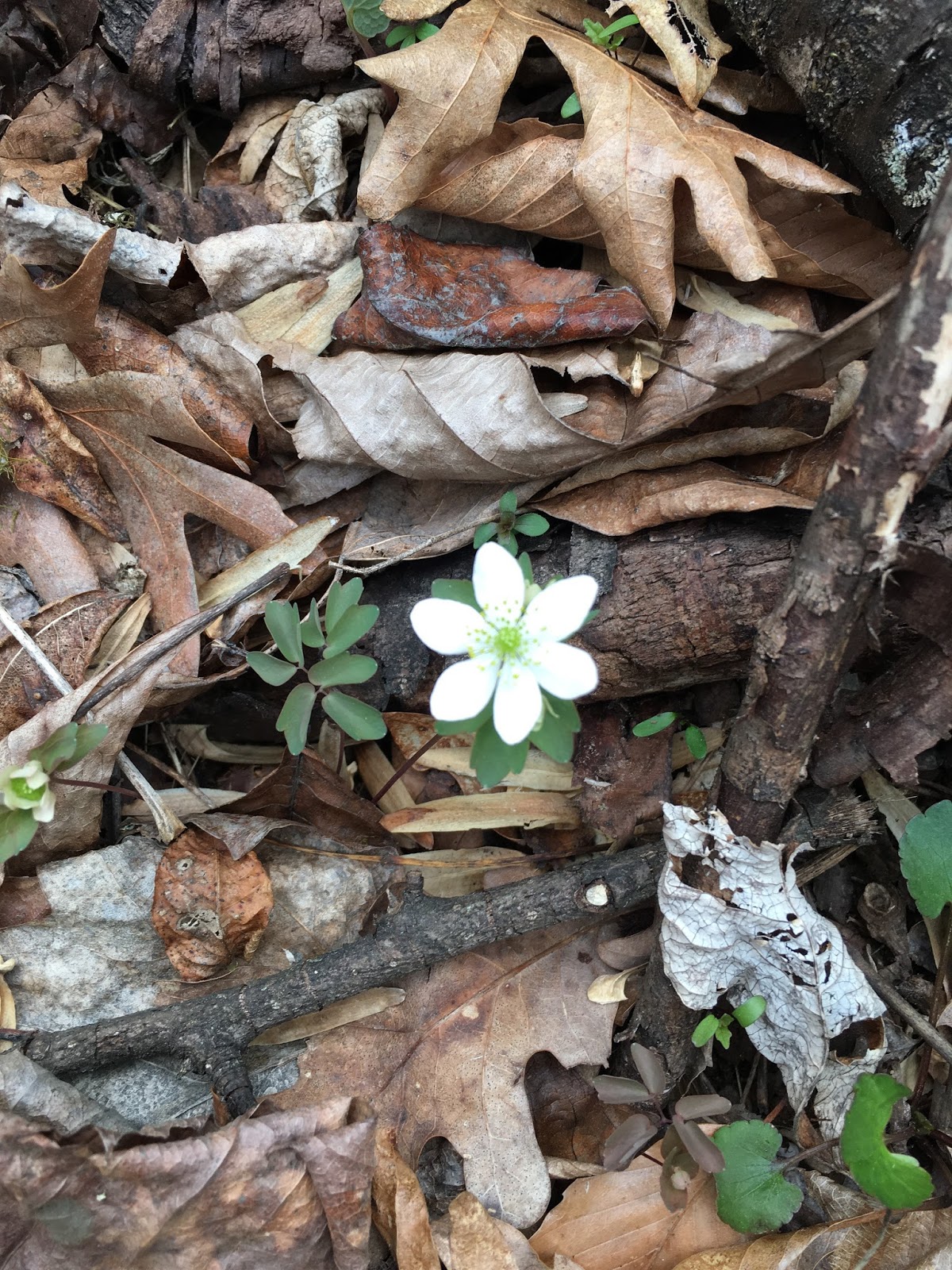 |
| Rue Anemone |
Come join us for a walk in the woods. July 15 and October 21 both at 2pm.
 |
| Jet Bead (Invasive) |
 |
| Removing Chinese Privet (Invasive) |
 |
| Spice Bush |
 |
| Princess Tree Seed Pod (Invasive) |
 |
| Wild Comfrey |
 |
| Barberry (Invasive) |
 |
| Five leaf akebia (Invasive) |
April 2, 2018
The Cacophony Outside
One of the things I have noticed in the past few weeks is just how many birds are singing outside. The songs have been slowly increasing in crescendo, along with those tell tale signs of spring. Being a part of the Master Naturalist organization one must admit to paying a bit more attention to these songs now.
My dog walks me at least a mile in the morning and night. He definitely likes to stop and sniff the proverbial rose so to speak. Just for the record, I do pick up after him, but that is another topic for another time. One of the most interesting things I have found is the number of bird songs heard while walking. It is coming to the point, songs that are new immediately stand out. Stopping we watch until the bird is located and identified. Surprisingly enough I am seeing bird species I have never seen in the wild before. Perhaps it is because my view has changed, but honestly it is due to paying closer attention. Not to mention slowly learning some of the songs.
This past week I saw my very first Cedar Waxwing, but wait there's more. I didn't see just one but seven. All flitting around in my neighbor's yard. Their high pitched call was new, not hearing that before. Initially I thought they were female cardinals, but then the yellow tail tip and belly and the black mask gave them away. I was so excited but alas the only camera with me was my phone and the birds were too far to get a decent picture. Not to mention my dog pulled me along saying it was time to go.
The next day, we stepped outside and I saw a rather large bird tossing mulch in the air in my flower bed. At first he looked a bit like a yellow bellied sapsucker, but that was not right. I ran in and grabbed my Sibley's Guide to North American Birds. A Northern Flicker with his pretty scallops black feathers. We sat down and watched him for quite awhile, after all he was hard at work in my garden turning it over for insects. His harassment of the squirrels was amusing.
My final treat for the week was observing a very small hawk fly overhead. Luckily my binoculars were with me. The size caught my attention, stopping to watch until he flew out of sight. Remembering important identification markings, I was able to look the bird up when I got home. An American Kestrel. Reading more about their habitat and conservation needs I realized this really was the treat of the week.
I understand why some of my fellow Naturalists are avid birders, while they probably have seen these species hundreds of times, it was new for me. When I have to sit inside and work, instead of digital radio I will simply listen to nature's concert going on outside my window and smile as now I know many of the lead vocals and it doesn't cost me a dime.
Subscribe to:
Posts (Atom)
